
Where the numbers become clubs.
A fitting produces a specification. The bench is where that specification is actually cut, bent, weighted and glued into a club you can put in your bag. From a simple regrip to a complete set rebuild, it is all done in-house.
A club, built.
Filmed in the Golf Concepts workshop — six stages, none of them a stock clip. The two longest run at 1.8× so they are not a long watch.
Measure
Nothing is cut until the number is confirmed.
The specification from your fitting is checked against the raw shaft on the bench before a blade goes anywhere near it. Length drives lie angle, so getting this one wrong does not just produce a club of the wrong size — it makes every other measurement on that club wrong with it.
Prep the tip
A join is only ever as good as the surface underneath it.
The bonding area is abraded back so the epoxy has something to key into. It takes a minute, nobody ever sees it, and a head that works loose halfway through a round is almost always a head where somebody decided to skip it.
Cut to length
Cut once, to your number.
Trimmed on the saw to your finished playing length. Steel and graphite are cut from opposite ends and behave completely differently under the blade, which is exactly why this is a bench job rather than something to attempt at home with a hacksaw.
Grip and finish
One movement, or you start again.
Fresh tape, solvent, and the grip goes on in a single motion before the solvent keys. Then it is squared to the face and left to cure. A grip fitted a few degrees out of square quietly teaches you to compensate for it every single time you take hold of the club.
Into the vice
The unglamorous half of the job.
Old grip off, tape stripped, shaft cleaned and squared in the vice. This is the part of a regrip nobody photographs, and it is the part that decides whether the new one sits straight when it goes on.
Loft and lie
Bent to your delivery, not to a catalogue.
The head goes into the bending machine and comes out at the angles your swing actually needs, rather than the ones a factory chose for an average golfer who does not exist. A fitting often turns up angles that are correctable right here, at R70 a club — considerably cheaper than a new set.
What bench work costs.
Per club, as listed on the board in the shop. A fitting often points at a bending job rather than a buying decision, and this is what that costs.
| Service | Per club |
|---|---|
| Lengthen golf club | R110 |
| Shorten golf club | R110 |
| Check lie angle and swing weight | R55 |
| Bend lie and loft angles | R70 |
| Grip thickening using old grips | R80 |
| Grip thickening buying new grips | R30 |
| Shaft replacement and glueing | R220 |
| Swing weight | R275 |
| Spine alignment and flowing | R275 |
Bench labour only — bring the bag in and Danie will quote you on the parts and the whole set together.
- New grips A set of high-quality, premium, world-renowned grips fitted for ultimate control and comfort.
- Re-shafting Need to replace a shaft? Our master fitter will fit your club with the ideal shaft for your play style.
- New shafts Upgrade to high-performance shafts that offer better distance, feel and accuracy.
- Club bending Fine-tune your lie and loft angles to optimise performance and consistency on the course.
- Spine align & swing weight Have your shafts aligned and weighted correctly, allowing for more consistently accurate shots.
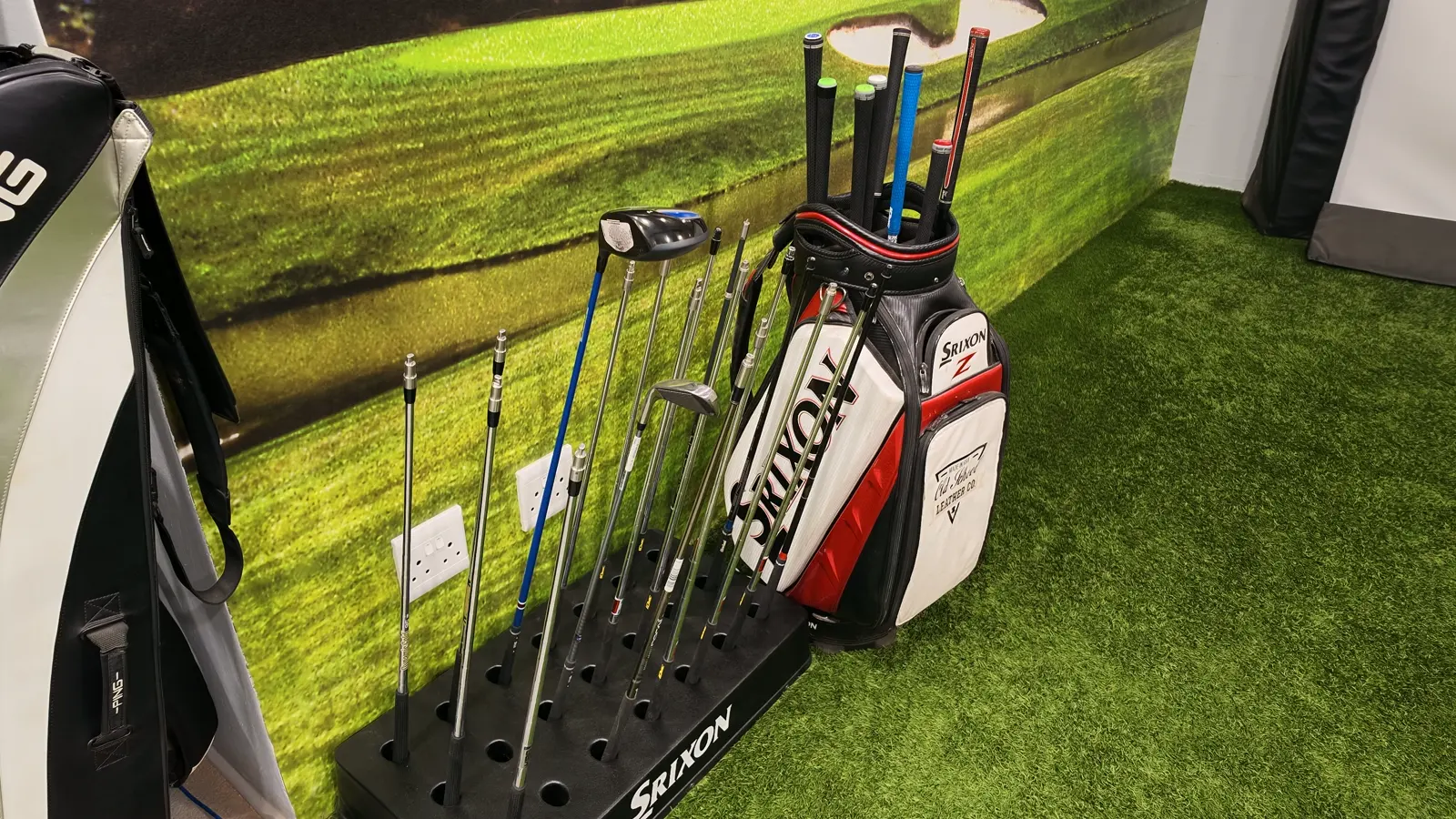
For all your club adjustments, talk to the master fitter.
Tell us what the club is doing wrong and we will tell you whether it is a bench job or a fitting job — they are not always the same thing, and the bench one is usually a great deal cheaper.
Clubs feeling tired?
A fresh set of grips is the cheapest shot-saver in golf. Bring the bag in and we will look at the whole set.